Hardware-attested cryptography, secured by network consensus.
A powerful and novel confidential computing network.
Access to data should never require its transfer
The T3 Network is a powerful and novel confidential computing network that guarantees the security, privacy, and compliance of every Terminal 3 solution.
Traditional data infrastructure requires data to be copied into applications for use, creating data liability, breach risk, and compliance burdens across your enterprise stack. The exposure grows with every system that touches the data, and especially so when AI agents become involved.
Use sensitive data without security, privacy, or compliance risks. The T3 Network enables enterprises to store, compute, and audit regulated and private data within hardware-secured storage, across boundaries and borders, without any risk exposure.
Every layer of T3 Network explained
From per-value encryption to data processing, ultimate privacy and security is native design in our architecture
Every value is encrypted with quantum-resistant AES-256-GCM before it leaves the client. Plaintext never travels to the network.
The encryption key is split across multiple independent TEE nodes using ML-KEM (FIPS 203). Decryption requires a quorum, so compromising one node reveals nothing.
Encrypted values stay in storage pinned to your jurisdiction. Data use does not require data transfer.
Computation runs only inside hardware-attested TEEs. Data is decrypted, processed, and re-encrypted within the enclave; operators, insiders, and AI agents never see raw data.
Every protected action and computation is written to a Merkle-tree-backed ledger, cryptographically signed and independently verifiable by any third party. The immutable audit trail is tamper-proof.
Use cases
Who T3 Network is for
T3 Network is built for companies, organizations, consortiums, and platforms that require data storage and processing across trust boundaries: institutional silos, competitive entities, or regulatory borders.
Multinational Corporation
One company, multiple jurisdictions
Your subsidiaries each hold private customer or operational data in their own country. You want to run analytics or reporting across entities without breaching data privacy or residency rules.
For example, a bank with entities in Singapore, the EU, and Japan.
Get a demo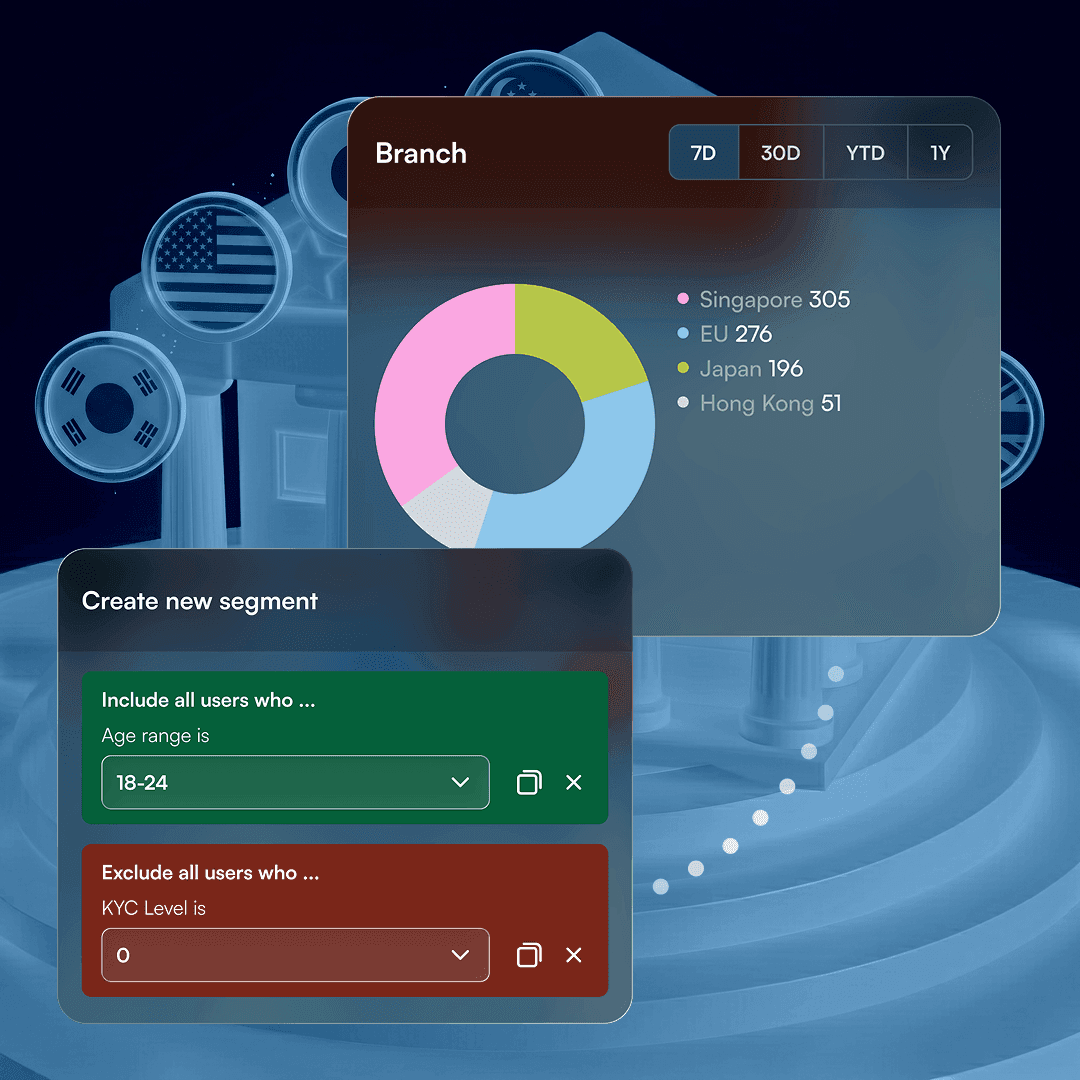
How the network secures your data
Security, privacy, and compliance, guaranteed by hardware-attested cryptography and network consensus
What a TEE provides
What network consensus adds
Security
Your code runs where no operator, insider, AI agent, or vendor can reach it.
- Sealed hardware isolation
- Resists privileged-access attacks
- Code changes detected and rejected by the network
- Security remains intact even if nodes are compromised
Privacy
Your data is stored and processed with complete privacy; no unauthorized party can access it.
- Raw values never exposed
- Data is encrypted before leaving client
- Compute runs across private data sources
- Keys split; quorum required to decrypt
Compliance
Every action is provable to a regulator or compliance officer, and data remains in its originating jurisdiction.
- Provable in hardware enclaves
- Data pinned to regions
- Signed, immutable audit ledger
- Verifiable by third parties
Security
Your code runs where no operator, insider, AI agent, or vendor can reach it.
What a TEE provides
- Sealed hardware isolation
- Resists privileged-access attacks
What network consensus adds
- Code changes detected and rejected by the network
- Security remains intact even if nodes are compromised
Privacy
Your data is stored and processed with complete privacy; no unauthorized party can access it.
What a TEE provides
- Raw values never exposed
- Data is encrypted before leaving client
What network consensus adds
- Compute runs across private data sources
- Keys split; quorum required to decrypt
Compliance
Every action is provable to a regulator or compliance officer, and data remains in its originating jurisdiction.
What a TEE provides
- Provable in hardware enclaves
What network consensus adds
- Data pinned to regions
- Signed, immutable audit ledger
- Verifiable by third parties
Built on T3 Network
Every Terminal 3 product runs on T3 Network and inherits its hardware-grade security, privacy, and compliance.
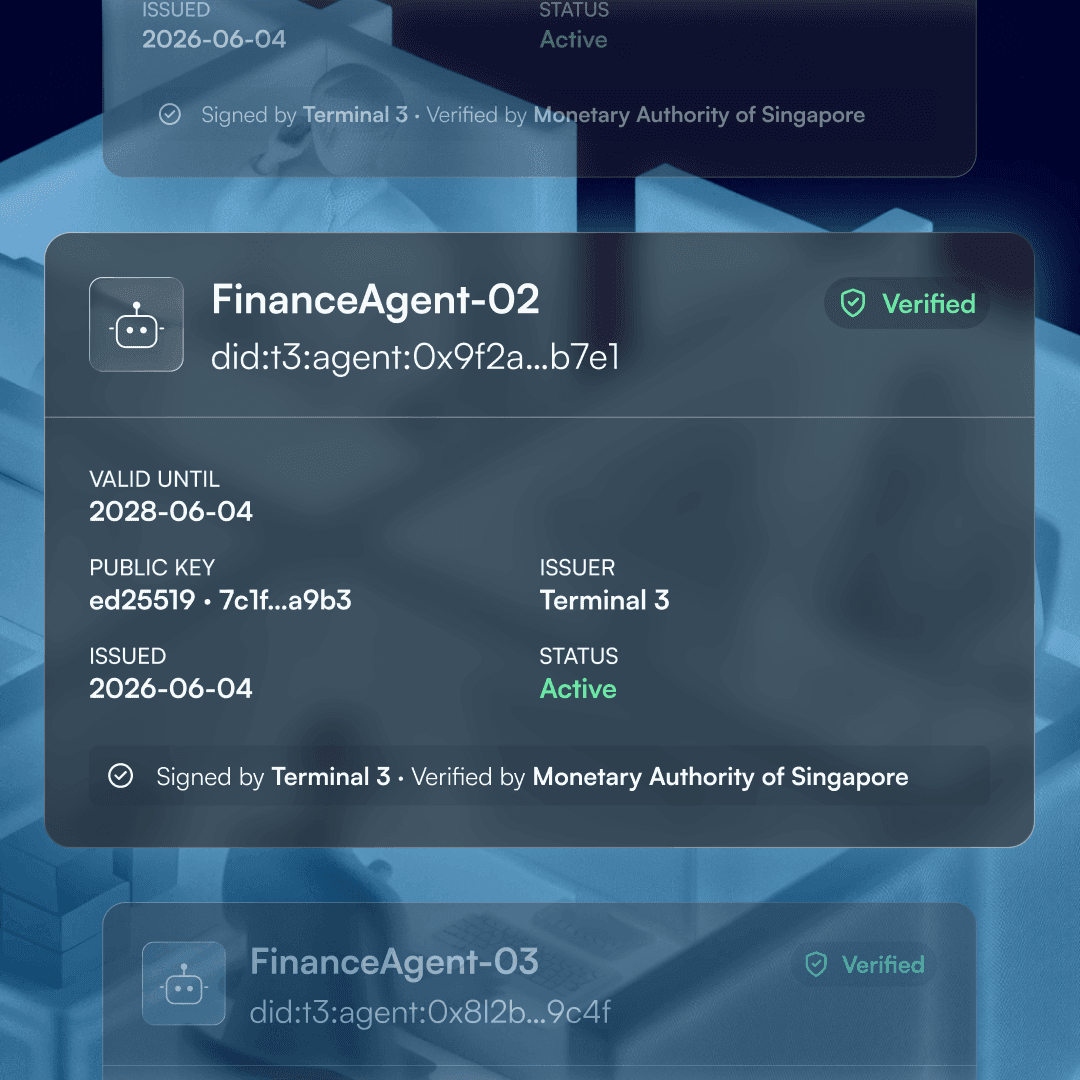
Secure and monitor your AI agent workforce.
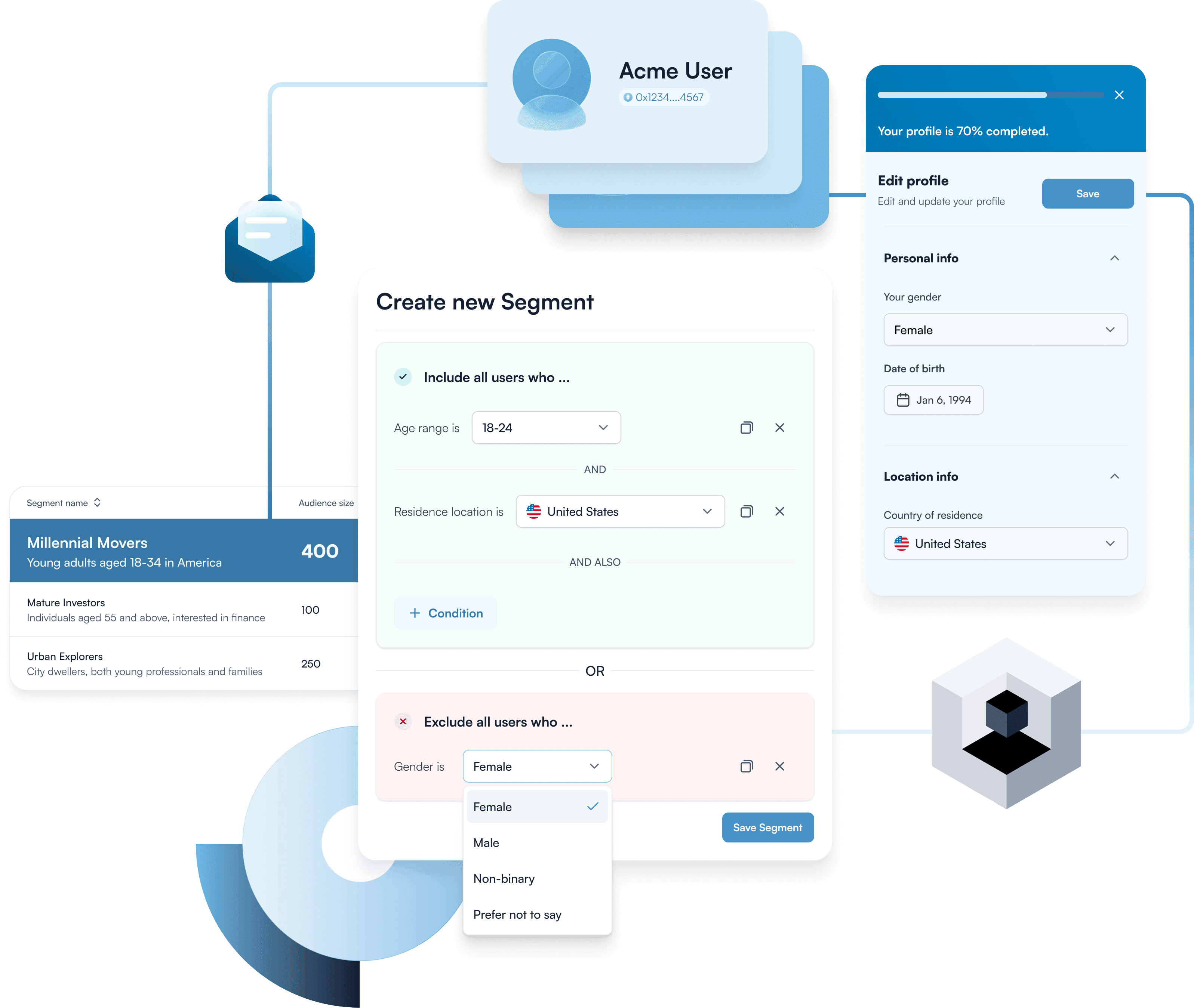
Issue verifiable digital identities and secure private data in self-sovereign storage.
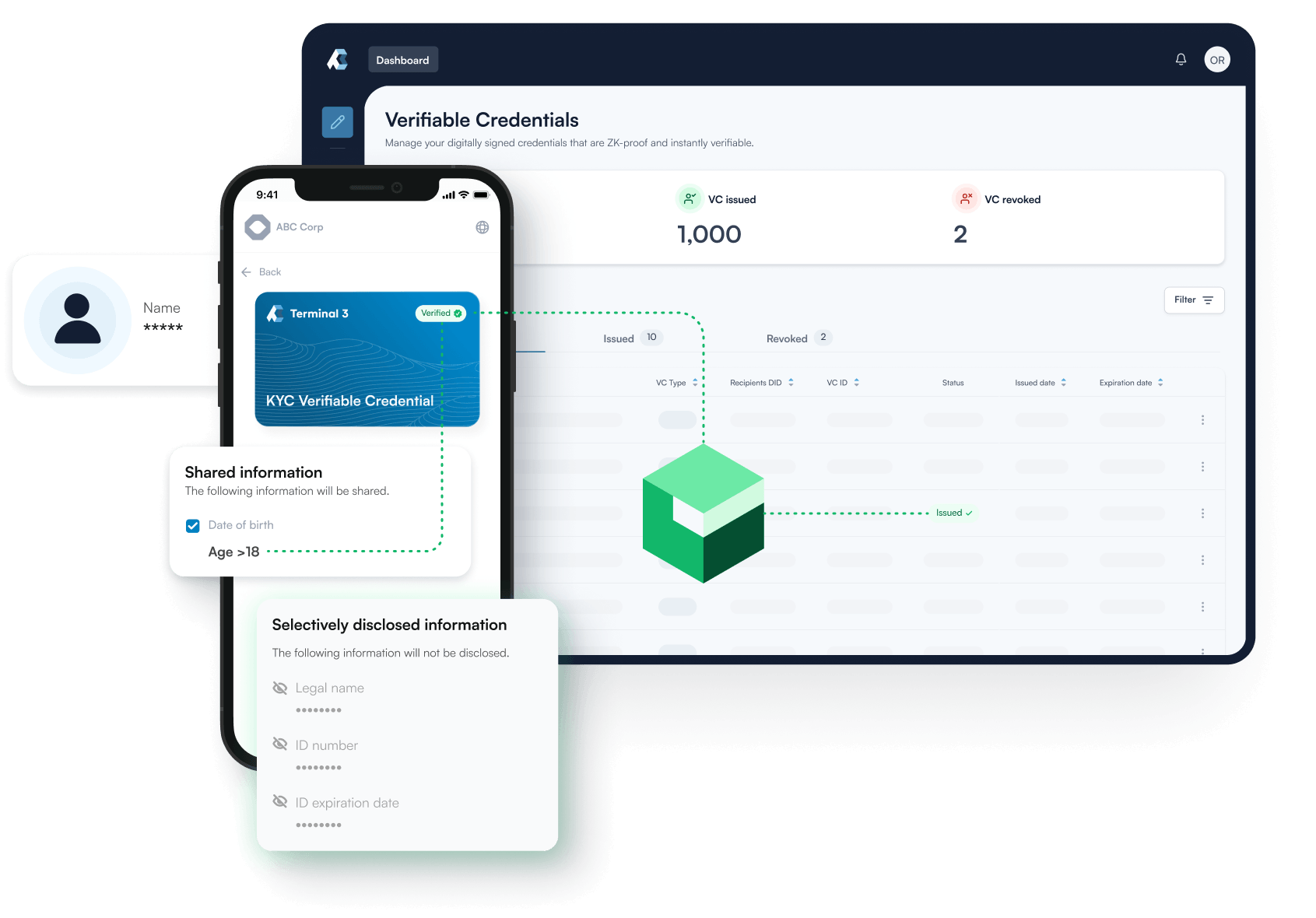
Issue and validate smart verifiable credentials, with just-in-time verification against protected data.
Give every agent a verifiable identity, payment credentials, and hardware-sealed secrets.
Flexible deployment for every institution
T3 Network runs on hardware-secured confidential compute. Pick the deployment model that fits your infrastructure and compliance needs, all three deliver the same hardware-attested guarantees.
Get a demoCompanies operate a dedicated node on the public-permissioned network, retaining data privacy while leveraging the full network security of T3 Network.
 Managed by Terminal 3
Security and compliance, built into the infrastructure
We take security seriously and have implemented robust measures to protect your data.


The trust layer under
everything you build
Access data through computation, not custody — the foundational guarantee every Terminal 3 product delivers