AI agents that transact — with cryptographic proof of every authorization
Agent Command issues policy-bound credentials to AI agents handling procurement, payroll, and payments. Approved vendors, spend limits, and category rules are enforced at the credential layer and logged in a tamper-proof ledger.

AI agents are being handed purchasing power without purchasing controls
Enterprise AI agents are executing procurement workflows with real financial exposure. The controls governing those actions live in application-layer policy: configuration files and prompts that can be overridden, misread, or bypassed.
Prompt instructions are not spend controls
An AI agent told to stay within budget is operating on a suggestion, not a constraint. There is no infrastructure-level enforcement of spend limits in current enterprise AI deployments. The risk is financial, scaling directly with the agent's capability.
Finance teams have no visibility into what agents are spending
AI-initiated procurement creates transactions that may not appear in approval workflows or purchase orders. By the time finance identifies an unauthorized payment, it has already cleared.
Audit trails for AI-initiated transactions are reconstructed, not cryptographic
When an auditor asks what an AI agent purchased, on whose authority, and under what mandate, the answer is assembled from logs and inferences. That is not the same as a cryptographic record that proves it.
Every agent transaction authorized, bounded, and auditable
Spend limits enforced at the credential layer, not application policy
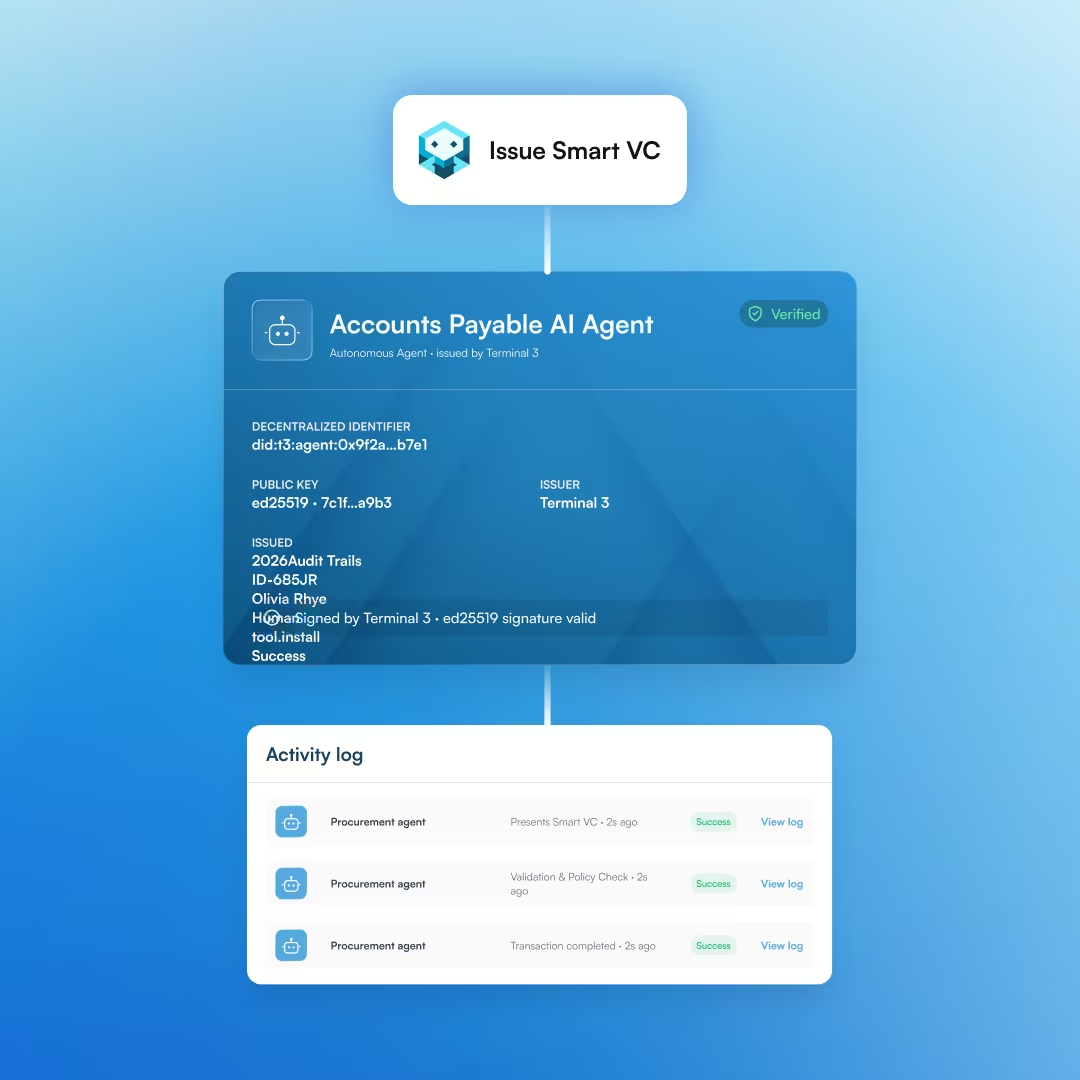
Every AI agent receives a Smart VC encoding its spending authority: maximum transaction size, approved vendors, spend categories, and time window. Actions outside those bounds fail before they reach the payment system.
Approved vendor enforcement before the transaction clears
Smart VCs encode the approved counterparty list for each agent. An agent cannot transact with a vendor not included in its credential. The restriction is cryptographic and cannot be overridden at the application layer.
A tamper-proof record of every authorized payment
Every procurement action, invoice approval, and payment instruction is logged in Agent Command's Merkle-tree ledger. Finance teams and auditors receive a cryptographically verifiable record rather than a reconstructed payment log.
Revoke spending authority instantly when a project or relationship ends
Agent credentials can be revoked immediately. When a contract ends, a vendor relationship changes, or an incident occurs, the agent's next attempted action fails at the credential layer without an application update or manual intervention.
The tools that power agentic payments
Agent Command issues procurement mandates; the Agent Developer Kit enforces them before any transaction reaches a payment system.
Agents receive cryptographic purchasing authority, scoped and bounded
Agent Command issues Smart VCs that encode an agent's procurement authority: approved vendors, spend limits, category rules, and expiry. The agent carries proof of what it was authorized to purchase at the moment of every transaction.
Cryptographic controls for AI-driven procurement
Smart Verifiable Credentials for payment authorization
Procurement authority is encoded in W3C Verifiable Credentials extended with programmable policy rules. Spend limits and vendor restrictions are cryptographic constraints that cannot be overridden at the application layer.
Merkle-tree audit integrity
Every agent-initiated payment is logged in a Merkle-tree structure anchored to the T3 Network. The audit ledger is tamper-evident: modifying any entry invalidates all subsequent records.
Quantum-resistant agent credentials
Smart VCs are signed using FIPS 204 post-quantum cryptography. Procurement authority records and audit trails remain cryptographically valid against future threats.
Build policy-bound procurement agents with the Agent Developer Kit
Agent Command and the Agent Developer Kit expose APIs for mandate issuance, policy enforcement, and audit log access.
Built for institutions that operate across regulated jurisdictions
We take security seriously and have implemented robust measures to protect your data.



AI agents that spend within their mandate — and prove it
Talk to our team about cryptographic procurement controls for your finance and operations stack.