Governed AI agents with cryptographic proof of every authorization
Agent Command issues cryptographically-scoped mandates to AI agents. Every action is bounded, logged, and provable, satisfying the requirements of MAS AI Risk Guidelines, MindForge, and enterprise governance frameworks.

AI agents executing workflows with real consequences need provable authority
Enterprise AI agents are executing workflows with real financial and regulatory consequences. The authorization for those actions typically lives in a prompt or a config file, neither of which is auditable, verifiable, or tamper-proof.
Application-layer policy can be overridden or misread
An AI agent's behavior is controlled by configuration, prompts, and application logic. A sufficiently capable model can misinterpret, circumvent, or hallucinate past those controls. None of it is cryptographically enforced.
Regulators are requiring explainable, auditable AI
MAS AI Risk Management Guidelines, the EU AI Act, and enterprise governance frameworks all require explainability, human oversight, and tamper-proof audit trails for AI systems in regulated contexts. Reconstructed logs don't satisfy this.
No current framework can prove what an agent was authorized to do
When an AI agent takes an action, the question any regulator or auditor will ask is: who authorized this, and under what mandate? Without cryptographic agent identity, there is no verifiable answer.
Agents governed by what they were authorized to do
Know Your Agent: verified machine identity for every action
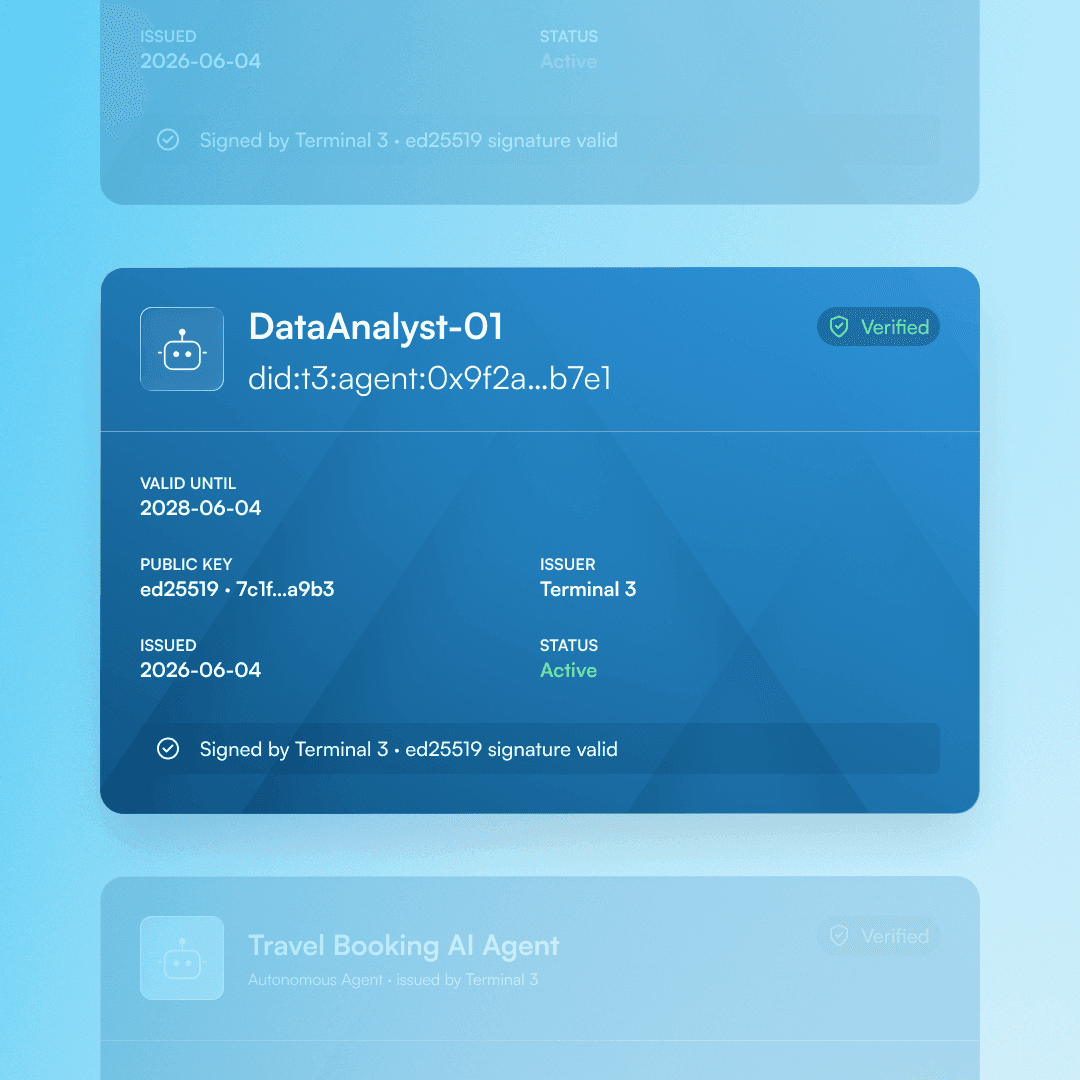
Every AI agent receives a signed, cryptographically-scoped credential (Smart VC) that identifies it, names its principal, and bounds what it can do. KYA brings the same rigour to machine identity that KYC brings to human identity.
Scoped mandates: agents can only act within what was signed
Agent credentials encode specific capabilities, spend limits, data types, and time windows. Actions outside the credential scope are rejected at the infrastructure level rather than by application-layer policy that can be overridden or misread.
Tamper-proof audit trail for every agent decision
Every action taken by an agent is logged in a Merkle-tree-backed ledger anchored to the T3 Network. The audit trail is cryptographically tamper-evident. Regulators receive provable records rather than reconstructed logs.
Instant revocation when an agent's mandate expires or is withdrawn
Agent credentials can be revoked immediately. When a project ends, a principal changes, or an incident occurs, the next action attempted by that agent fails at the credential layer without a manual process or application update.
The tools that power enterprise AI governance
Agent Command and the Agent Developer Kit work together. Agent Command issues mandates and logs actions; the ADK enforces them at runtime.
Every agent gets a verifiable identity scoped to its mandate
Agent Command issues Smart Verifiable Credentials to AI agents. Each credential is cryptographically bound to a principal, scoped to specific capabilities, and limited in time. Agents carry cryptographic proof of their authorized scope, independently of what they were prompted to do.
Infrastructure-grade AI governance
MAS AI Risk Guidelines alignment
Agent Command's four pillars — Visibility, Control, Privacy, and Auditability — map directly to MAS AI Risk Management Guidelines (2025) and the principles from MAS Project MindForge.
Merkle-tree audit integrity
Agent action logs are structured as a Merkle tree anchored to the T3 Network. Each entry is cryptographically linked to the prior. Tampering with any record invalidates all subsequent entries.
Quantum-resistant agent credentials
Smart VCs are signed using FIPS 204 post-quantum cryptography. Agent governance records and audit trails remain cryptographically valid against future threats.
Build governed AI agents with the Agent Developer Kit
The Agent Developer Kit exposes APIs for agent credentialing, mandate enforcement, and audit log access, compatible with major LLM providers and enterprise AI frameworks.
Built for institutions that operate in regulated AI environments
We take security seriously and have implemented robust measures to protect your data.

AI agents that can prove what they were authorized to do
Talk to our team about cryptographic AI governance for your enterprise or financial institution.