01
Onboarding & Issuance
User completes KYC with a regulated issuer. Terminal 3 encrypts and stores the data in the T3 Network and the Regulatory Vault, then issues a Smart VC to the user's wallet before recording the result to an immutable ledger.
Stablecoin issuers satisfy KYC/AML obligations without storing private data. Issue Smart Verifiable Credentials at wallet creation, fulfill Travel Rule requirements, and enable compliant transfers across protocols and jurisdictions.
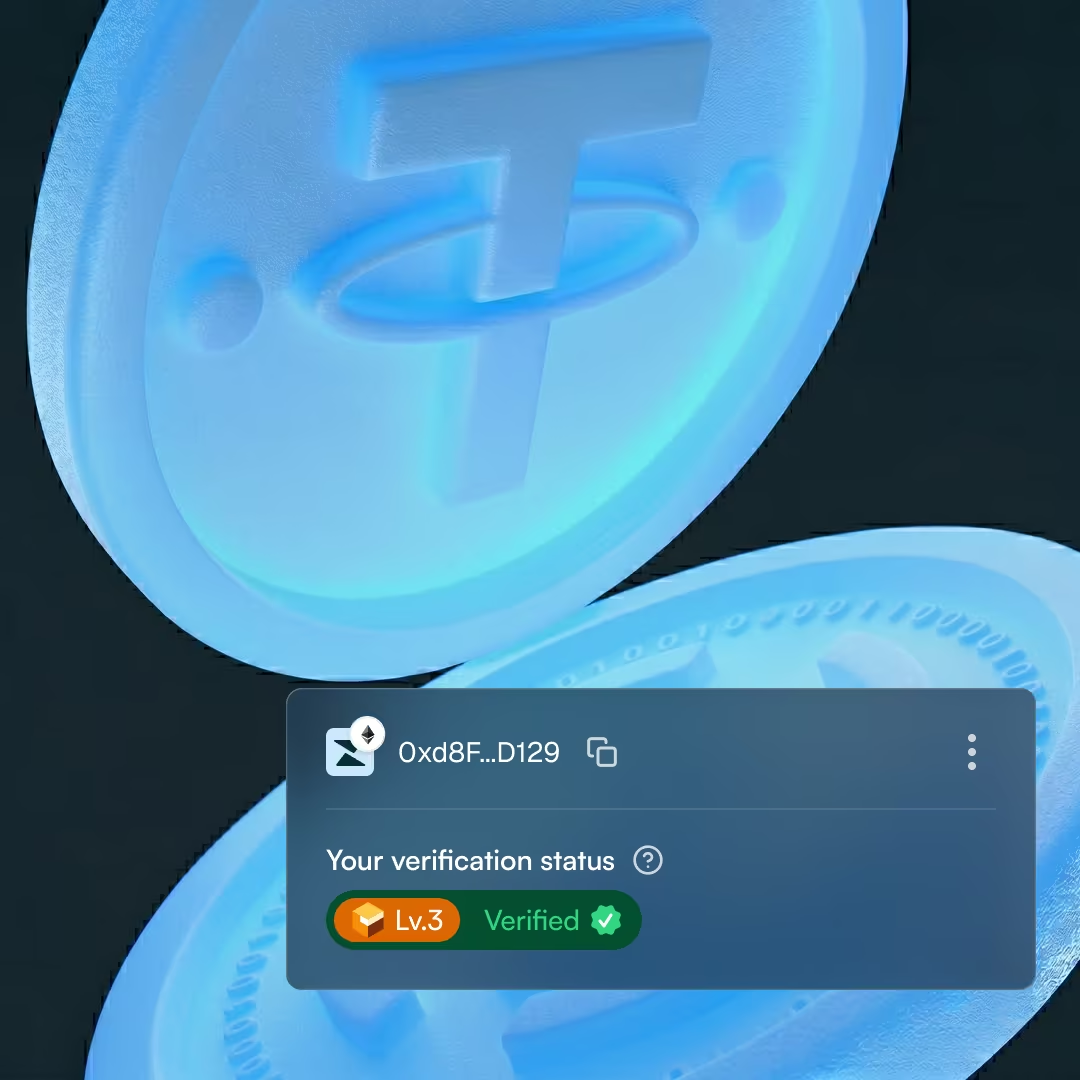
Regulated stablecoin issuers must verify the identity of every wallet at onboarding, satisfy Travel Rule obligations on every transfer, and prove compliance to regulators across multiple jurisdictions. Today, that means running separate KYC checks at every integration point, building bespoke data pipelines, and accumulating PII liability with every new protocol partner.
The result is fragmented compliance coverage, redundant data collection, and no portable proof of identity that one institution's check can satisfy another. Every stablecoin issuer starts from scratch because there is no infrastructure layer that bridges KYC and the chain.
Issue a Smart Verifiable Credential at wallet onboarding from any regulated KYC provider. Identity travels with the wallet across every protocol and chain — no re-verification at each touchpoint, no duplicate onboarding flows.
Satisfy FATF, FinCEN, and MiCA Travel Rule requirements by proving counterparty KYC status with a cryptographic proof. Originator and beneficiary institutions confirm compliance without exchanging personal data or creating new custody liabilities.
Verified wallet addresses are written to cross-protocol on-chain whitelists managed by the T3 Network. Smart contracts and applications reference these whitelists for trustless, permissionless KYC checks — no off-chain oracle required.
When a wallet is flagged, sanctioned, or a SAR is filed, the issuing institution revokes the credential immediately. Any subsequent presentation of that credential across any protocol fails — removing bad actors from the entire ecosystem in real time.
Identity, verification, and on-chain compliance for regulated digital assets.
T3 Identity converts KYC verification into a W3C Verifiable Credential signed by the issuing institution. The credential encodes identity claims rather than raw data and is held by the wallet owner. T3 stores no PII — GDPR and data residency obligations resolve at the architecture layer.
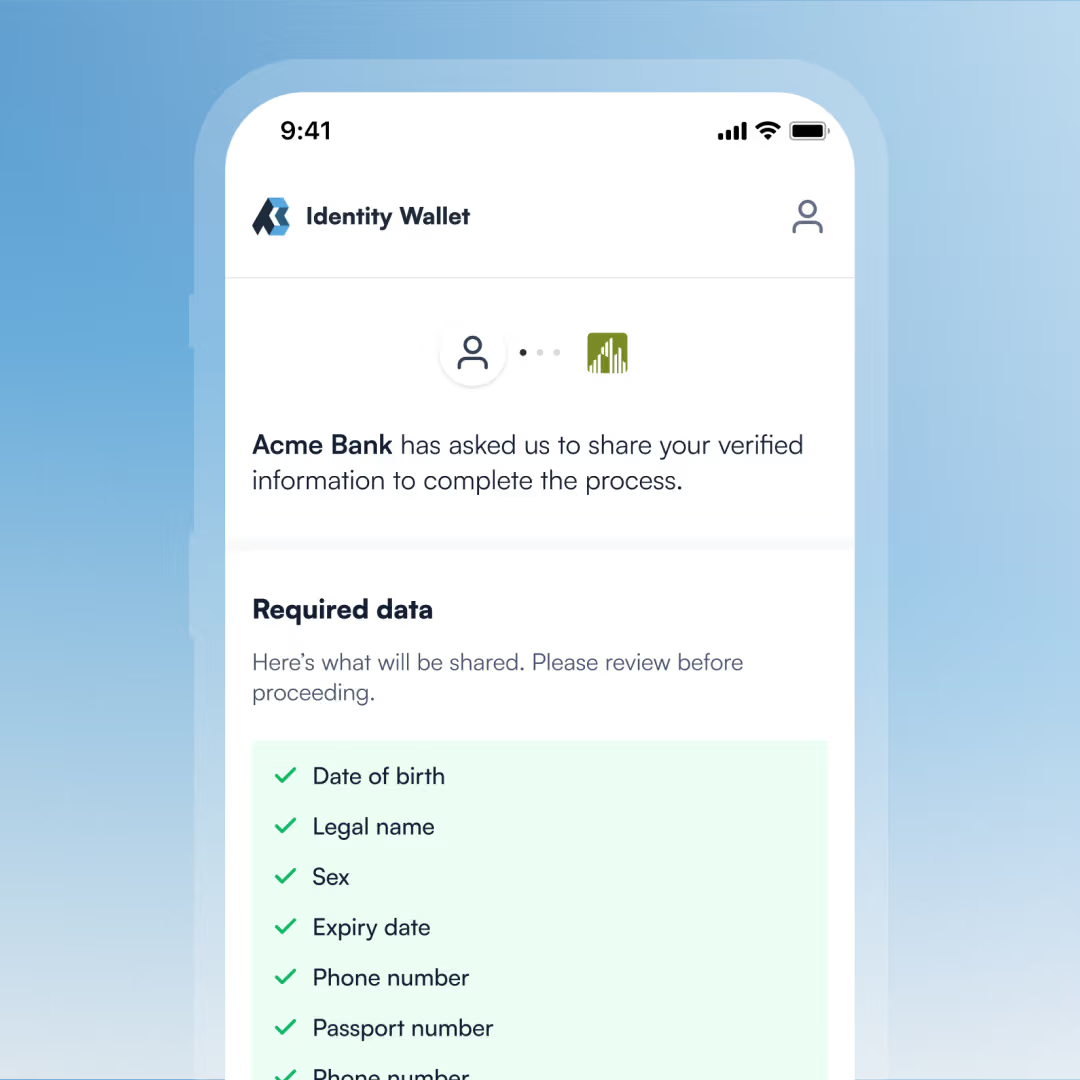
Credentials are issued in the W3C VC data model and OpenID for VCs standard. Any institution or protocol accepting these standards can verify wallet KYC without custom integration or bilateral data-sharing agreements.
All PII is stored encrypted in the T3 Network Regulatory Vault. Credentials encode claims, not data. Right-to-erasure, data subject access requests, and data residency requirements are satisfied without building bespoke compliance tooling.
Credentials are signed using FIPS 204 post-quantum cryptography. Verification proofs remain valid against future cryptographic threats, ensuring stablecoin compliance infrastructure remains secure for the long term.
T3 integrates with on-chain whitelist registries and off-chain KYC providers. Wallet credentialing, Travel Rule compliance, and revocation in a single API — no raw KYC data on-chain.
Designed for regulated financial use cases. Each credential is issued once and verifiable without data transfer, while authorized personnel retain the ability to audit and retrieve all necessary data.
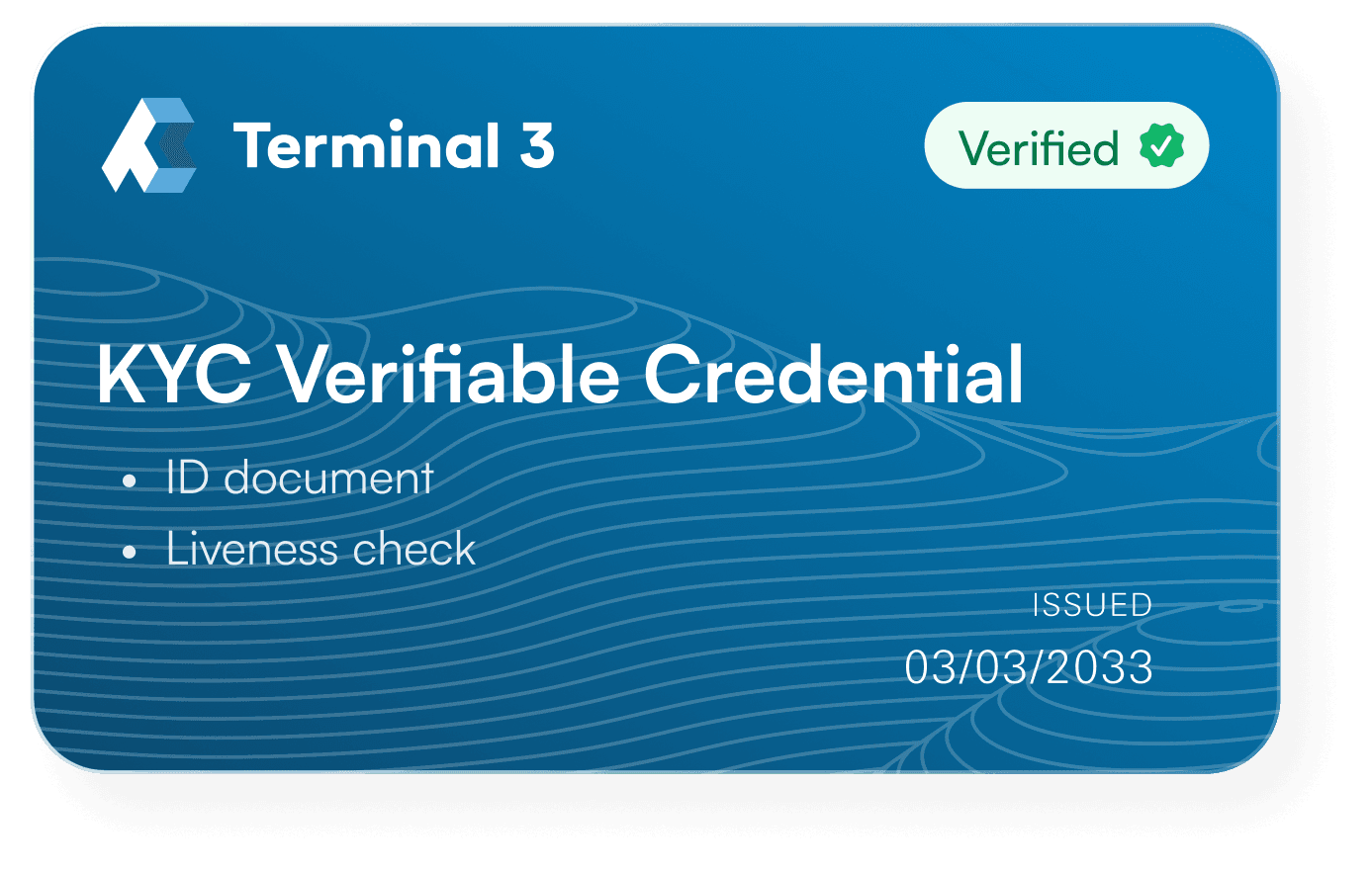
User completes KYC with a regulated issuer. Terminal 3 encrypts and stores the data in the T3 Network and the Regulatory Vault, then issues a Smart VC to the user's wallet before recording the result to an immutable ledger.
When a credential is accepted, T3 Network can dynamically provide retrieval process to the verifier's authorized personnel, satisfying data custody requirements without transferring raw PII. Applications see proof of compliance, never the underlying data.
When KYC data is required, authorized personnel can retrieve data via a permissioned portal. SAR and STR compliant data is released by T3 Network while the retrieval request is cryptographically recorded.
We take security seriously and have implemented robust measures to protect your data.


Talk to our team about wallet KYC, Travel Rule compliance, and on-chain identity for your stablecoin or digital asset protocol.